

The earliest recorded schoolmasters in Hoxne included Mr Sallett in 1595 and John Hall from 1635 to 1665. John had attended Caius College, Cambridge and had been a schoolmaster in Eye from 1624. Oliver Hall was appointed schoolmaster on 2nd May 1664/5. Possibly this was the son of Oliver Hall, a previous vicar of Hoxne, who left in 1646 to become vicar of Stoke Ash. In 1698/99 Mrs Fisher was a schoolmistress, teaching little Jack Hawes in 1699.
In 1734 Thomas Maynard left his real estate in Hoxne to Charles, Lord Maynard on the condition that he should spend £300 in erecting houses for a schoolmaster and schoolmistress to live in and that he should pay yearly out of the rents from the estate £40 to the master and £10 to the mistress for teaching freely all the boys and girls of the parish that were sent to them. Both boys and girls were to be taught reading, writing and arithmetic and the girls also to be taught needlework.
Charles, Lord Maynard erected 2 dwellings and 2 schoolrooms and conveyed them to trustees in 1742, together with the yearly rent charge of £54 out of the manor of Hoxne Hall. This was to pay the salaries of the schoolmaster and mistress and included an additional £4 for coal for the 2 schools.
The schoolhouse was attached to the rear of Hill House which became the schoolmaster's house. Hill House had been built years before so must have been purchased rather than newly built.
The schoolhouse became the doctor's surgery in 1920 when it was purchased in the Oakley Park Sale, along with The Firs, by Dr Herbert Christal, and then, in 2005, it became a residential property.
The 1777 church terrier contained the following information:-
"There is also one dwelling house situate near the Workhouse for the master of a free school for forty boys and a mistress do. for twenty girls with separate school for such, lately built and established by the Rt. Hon. Lord Maynard. The boys are now taught by Thomas Howell whose salary is 40 pounds per annum with an allowance of 40 shillings per year for firing. The girls are now taught by Ann Curtis whose salary is yearly 10 pounds with the same allowance for firing."
The schoolhouse was built in about 1761.
In May 1789 Thomas Howell died. He had been the steward and clerk to Thomas Maynard Esq. and master of the free school.
In 1841 a boarding school for young ladies was run by the Misses Pearl at Elm House. They had 9 pupil boarders.
About 30 boys and 20 girls were instructed in 1844 when the schoolmaster was Herbert Ward and the schoolmistress Mary Aldous until 1854. In 1841 the schoolmistress was Elizabeth Taylor. In 1851 Fanny Claxton was also a schoolmistress. In 1855 Mrs C. Cracknell was the schoolmistress and Herbert Ward still schoolmaster. 1858 Miss Morley was schoolmistress.
Presumably the present school building was built around 1860 and became the National School.
Larch House at Heckfield Green (also known as 41 Heckfield Green and the School House) was the home of the schoolmasters. On the 1861 census Mrs Elizabeth B. Miller, a widow, is recorded as schoolmistress with 16 years old Emma Weavers as 2nd year pupil teacher. On the 1871 and 1881 censuses Jonathan Howe and his family lived there. In 1871 Miss Emily Richards, the assistant school mistress, boarded there.
In 1865 Misses Jane and Louisa Cracknell were recorded as running a preparatory school at Rose Villa, Denham Road. This could not have continued for very long as Louisa married in 1868 and Jane married in 1869 .In 1865 Herbert Ward was still schoolmaster of the free school and Jonathan Howe master of the National school.
In 1871 Elizabeth Lubbock, with her Aunt Amelia Lubbock, was running an 'Establishment for Young Ladies' in Cross Street. Elizabeth had previously been a teacher, in Denham, living with the Bayles family. In 1871 they had one boarding pupil. They were still in Cross Street in 1875 but by 1877 they had moved to The Laurels in Low Street. The Laurels was the original name for the Red House, the neighbouring cottage taking the name at a later date. By 1881 Elizabeth's sister, Jane, had joined her and they had 5 boarding pupils. Jane had previously been a governess in Essex. Their father died in 1882. By 1891 they are both living, as governesses, with their mother in Great Yarmouth, so it is presumed that they left Hoxne, to be with her, some time after their father died.
In 1874 one of the schools built by Charles Maynard was converted to an Infant School teaching about 30 boys and 20 girls.
Herbert Ward died in 1875 and was buried in Hoxne, on the 15th April, age 77, and appears to have been master of the Free School until his death.
By 1875 there is no longer any mention of the free school. Jonathon Howe is master of the National school and Miss Cumpling mistress of the Infants school.
Kelly's directory of 1879 records :- There is an infant school supported by a charge upon the estate of Sir E. C. Kerrison, bart.; likewise a National and a Sunday school. Jonathon Howe master of the National school, Miss Shanks mistress of the Infants.
Kelly's Directory of 1883 records that the National school is mixed, is located in Cross Street and has an average attendance of 140. Jonathan Howe still the master and Miss M. Roberts the assistant mistress. The Infants have an average attendance of 30 with Miss H. Boultwood as mistress.
Jonathan Howe left Hoxne in about 1884 to become a grocer and draper in Stoke by Nayland, Suffolk.
He was replaced by George Henry Elam who moved on to teach in Staffordshire by 1887.
In April 1885 an advert for an assistant mistress of Hoxne Church School was placed in the Ipswich Journal. The yearly salary offered was £35. Interestingly the same advert was place in 1886 but the salary was reduced to £30.
In 1887 a Night School was run by Mr Hughes.
Kelly's Directory of 1888 notes that the National school in Cross Street was built for 150 children and had an average attendance of 115 with Charles Hughes as schoolmaster. The Infant school built for 50 children had an average attendance of 21 and was supported by a charge on the estate of Lady Bateman. Miss Emma Elger was the schoolmistress. By 1892 this has changed to Miss Emily Atkins and the average attendance for the National school to 121.
The 1891 census records Charles Hughes living at Larch House with his family. His wife Amelia is noted as Assistant teacher and his 16 year old daughter Charlotte M. Hughes as a pupil teacher.
By 1896 average attendance at the National school had increased to 161 but that of the Infant school was only 10. Miss Emma Schulver was mistress of the Infants.
The Dame Mary Kerrison Trust Estate sale of 1897 has Larch House as Lot 94. It is described as The School House as let to the School House Managers for £8 per year and occupied by Charles Hughes.
By 1900 the National school must have been extended as it had the capacity for 172 children although the average attendance was only 150.
On the census of 1901 Henry Norman is the schoolmaster (he started at the school on the 11th February 1901) living at Larch House with his mother Emma and his sister Emily Norman who is the schoolmistress.

On the 21st March 1903 a conveyance made by Lady Bateman of Brome Hall gave the school building, land and outbuildings to a board of managers. William Hayward of Corner Farm, Chickering, David Brown of Abbey Farm and the Rev. Cecil Downton were school managers at that time when the school became known as the Cross Street Voluntary School.

At this time the school had 2 classrooms which were later opened up into one large room that could be divided up by screens.
In 1908 the National School could have 189 pupils but only had an average of 154. Henry Norman was the master. The average attendance of the Infants School was 20 and Miss Ethel Cave was mistress.
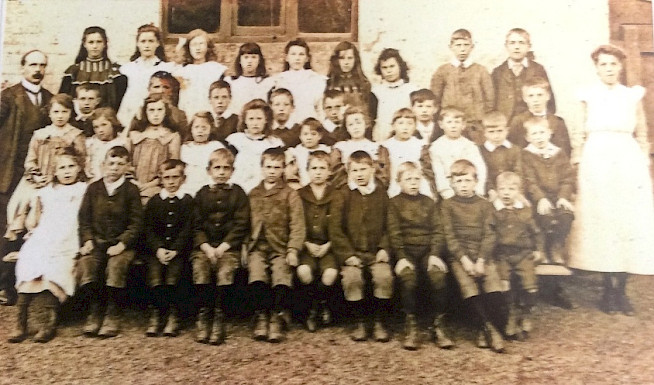
By 1911 Henry Norman had married and had 3 children. Isabel Pretty was lodging with them and was a certified assistant at the school. She joined the school on the 22nd November 1909 and left on the 21st August 1921 to be married.
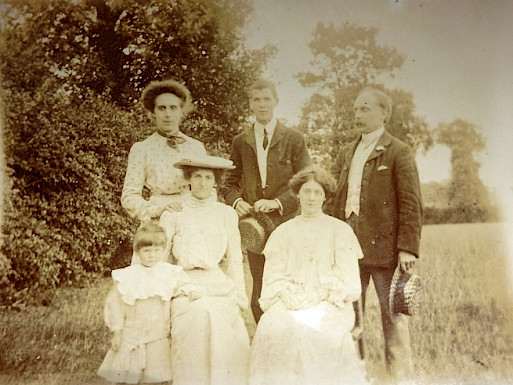
Hoxne School Teachers - Mrs Snell (teacher), Leslie Henry Norman (music and art teacher), Henry Norman, young boy, Mrs Norman and Ethel Cave(teacher)
By 1912 the National School could take 180 children and had an average attendance of 156. Henry Norman was the master. The Infants had a capacity for 40 children with an average attendance of 21. Miss Caroline Butcher was mistress.

In 1914 the Infant School was merged with the Cross Street School when a infants' classroom was added, together with a juniors' classroom and store rooms. During the alterations some classes were held at St. Edmund's Hall. The cost of the building work was £1,450 and it was carried out by Mr A.J. Gibbons of Crowfield.

In 1916 the National School was referred to as a Public Elementary School run by Hoxne Council for 204 children with Henry Norman still as headmaster.

School Group with Henry Norman as headmaster
In 1920 Larch House ceased to be the home of the schoolmaster when Henry Norman and his family moved to The Vicarage at Denham where he became a churchwarden. Later his eldest son Leslie went on to become a headmaster in Nottinghamshire, his youngest son Eric became a member of staff at the County Modern School at Halesworth and his daughter, Mrs Mary Stock, was headmistress at a Copdock school.
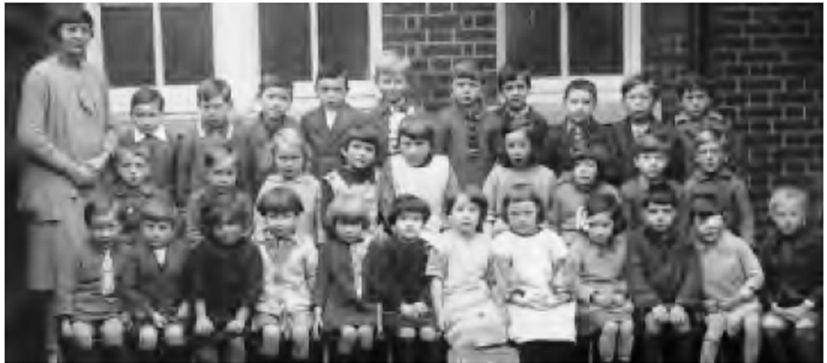
Back Row, L to R: Miss Dora Wace (a firm but highly respected teacher); Major Butler; Walter Doling; Arnold Hart; Gordon Baldwin; Gordon Thirkettle; John Westrup; ?; Ronald Tucker; George Mills; Charlie Knights.
Middle Row, L to R: ?; ?; Mary Quinton; Margaret Hammond; Margaret Westrup; Hilda Barber; ?; Hubert Steward; ?.
Front Row, L to R: Nigel Jolly; Jack Lawes; Peggy West; Rosemary Lines; Sheila Jolly; Daphne Lawes; Dora Braeme; Joan Drane; ?; Herbert Allington; Albert Goddard; Leonard Denny.
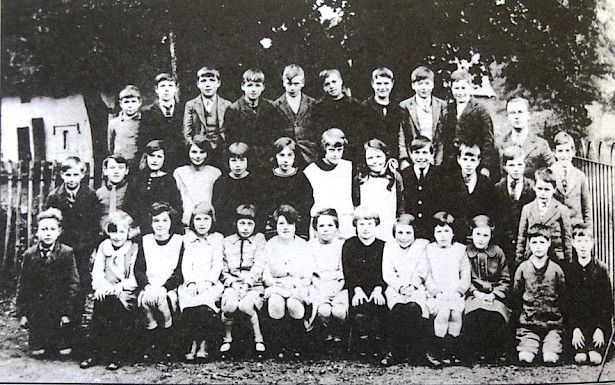
Back Row: Gerald Goddard, Douglas Grey, Hammond, Jack Feavearyear, George Harsent, Claude Pipe, Will Pipe, Fred Chapman, Jack Barber.
Middle Row: James Feavearyear, Harold Tyler, Trissie Pipe, Alice Lawes, Kathleen Hall, Margaret Gardiner, Sheila Saunders, Bennie Drane, Clarence Chenery, Reg Baxter, Jack Carter, Tommy Hall, Gordon Whitton.
Front Row: Alfred Day, Laura Thirkettle, Iris Mayes, Hilda Batley, Valda Jolly, Vera Cason, Kathy Filby, Barbara Saunders, Irene Lawes, Kathy Gittens, Winifred Whatling, Jeff Pipe, Roy Gardner
The teacher in the picture is Arthur Vincent Balls, a teacher at the school from 11th July 1927 to 31st December 1932. In 1935 he left Hoxne to become headmaster of the school in Worlingworth only to return to Hoxne in 1941 as headmaster.
In 1933, after 32 years service as headmaster, Henry Norman retired. He was presented with a gold watch from the past and present staff and scholars. A number of people were present at this ceremony. They included Rev. J. K. Wood and Mr H. Mutimer (School Managers), Mrs Page, Mrs Borrett, Mrs Howlett and Mrs Healy (old staff), together with the present staff and a number of old scholars.
Later Mr and Mrs Norman were presented with a silver Georgian tea service and a book of subscribers including the names of the school managers, old scholars and parishioners. One old member of staff, Mr V. Boles, travelled over 30 miles by motor bike to be present. Mr Harold Stevens became the new headmaster on the 1st May 1933.
On 31st August 1941 Mr Stevens left Hoxne to become headmaster of Kessingland Upper School. He was replaced by Mr Arthur Vincent Balls, headmaster of Worlingworth School, who commenced his duties on the 3rd November. A. V. Balls lived at the White House in Low Street until at least 1978. It appears that he emigrated to Australia on his retirement and died there in 2004.
In 1946 Mr William Arthur Banham was one of the school managers.
During the 1950s and 1960s the Infant school teacher was Mrs Lindley, the juniors were taught by Mrs Olwen Chapman and the seniors by the headmaster Mr Balls.
In 1953 Senior children from Hoxne School visited London to view the Coronation decorations. They were accompanied by the headmaster, Mr Balls and his wife and 2 other teachers, Mrs Chapman and Mr Pegg.
Margaret 'Jess' Thompson (20th Jan 1923 - 10th May 2013) was head teacher at Hoxne Primary School from 1976 to her retirement at the end of July 1985. Under her the number of pupils had grown from about 60 to 75.
In September 1985 Mrs Rosemary Howard was appointed head teacher of Hoxne Primary School. She had previously been deputy head at Bacton County Primary School